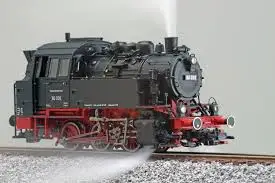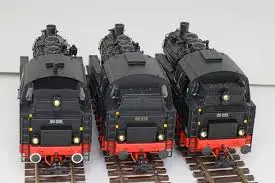
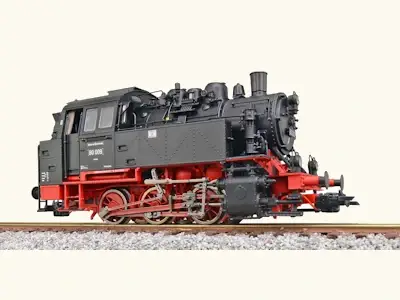
The Deutsche Reichsbahn-Gesellschaft (DRG) standard steam locomotive program also included a three-axle series for heavy shunting duties. For this series, the DRG prescribed a maximum axle load of 17.5 tons, which was only slightly exceeded at 18.1 tons during inspection thanks to a few tricks. These made optimal use of the railway networks in shunting yards and industrial areas near major cities. Unlike the numerous, mostly larger locomotives dating back to the state railway era, the Class 80 series was more powerful and, at the same time, more economical. Because of their imposing boilers, these 0-6-0 locomotives were nicknamed “Bulli.” Despite the undeniable advantages of the modern design, the DRG stuck with the 39 units purchased in 1928 and 1929 due to the difficult economic situation. Mostly at passenger stations, the locomotives zipped across the tracks at the maximum permitted speed of 45 km/h. By 1966, these reliable locomotives had disappeared from the shunting yards of the two German state railways. V60 locomotives of both designs provided similar tractive power but were even more versatile due to their higher top speed. At less than 40 years old, however, the Class 80s weren’t ready for the scrap heap just yet. Both state railways used the “Bullis” in repair shops or sold them to industrial companies or coal mines, which gratefully put the proven locomotives to use. For example, a handful of Class 80s worked in coal mines in the Ruhr area. There, they were even used for internal passenger trains. The last operational “Bullis” were 80 036 and 80 039 from the Museumseisenbahn Hamm, which were transferred to the Veluwsche Stoomtrein Maatschappij (VSM) in the Netherlands. Deutsche Reichsbahn’s 80 009 holds a special status, as it was the only state railway locomotive sold to a private individual during the GDR era. Engine driver Klaus Hollenbach acquired the locomotive in 1981 with great effort, transferred it under its own power, and built a locomotive shed and a short “siding” on his private property for his 80 009, which was hoisted onto the rails with two truck cranes in 1982.