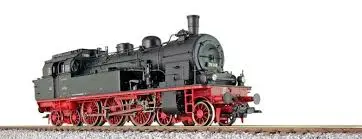
The T18, developed by the Vulcan locomotive factory in Stettin, was created following a request from several Prussian railway companies for a tank locomotive that could reach speeds of at least 90 km/h in both forward and reverse. Built between 1912 and 1927 with a total of 462 units produced by various manufacturers, the T18 is considered the most successful Prussian state railway tank locomotive for passenger trains. It was used by the Deutsche Reichsbahn (DR) until 1972 and by the Deutsche Bundesbahn (DB) until 1974. The symmetrical chassis ensured equally good handling in both directions, and the boiler, based on the G8 design, had already proven its worth by the time production of the T18 began. With an output of 1,140 hp and a top speed of 90 km/h (increased to 100 km/h from the eleventh locomotive delivered), these locomotives were also used to pull express trains. Shortly after the Second World War, the German Federal Railways (DB) resumed trials with push-pull trains to shorten the turnaround times of local trains. To this end, a number of the 424 locomotives still in service with the DB were equipped with an indirect push-pull control system from Hagenuk. With this system, when the train was being pushed, the driver could relay driving commands from the control cab via a control panel to the fireman on the locomotive, who then operated the regulator. As soon as the driver braked, the regulator was automatically closed by compressed air from the control cab. Later, the push-pull control system was removed from most 78.0-5 locomotives, and they were put back into service for light passenger and freight trains. The DB consolidated its Prussian locomotives in Baden-Württemberg in the early 1970s. After the Second World War, the East German State Railways (Deutsche Reichsbahn) had 53 locomotives of the 78 series at their disposal. To improve the driver’s visibility, some locomotives at the Stralsund depot were fitted with small smoke deflectors.
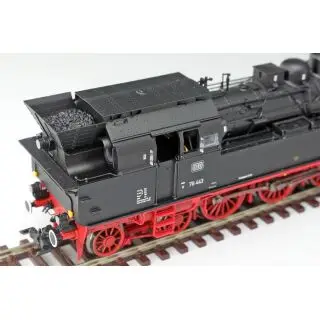
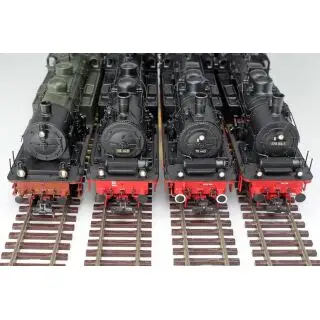
As you can see in the photos, our T18 (BR78.0-5) is stunning and features various lanterns, feed pumps, piping, cab roofs, and coal bunkers, depending on the era. What you might not notice right away is the cylinder steam, a new feature for ESU steam locomotives. In the prototype, this was produced by draining condensation. Since cylinder steam isn’t released in every driving situation on the real locomotive, our H0 model behaves accordingly. Of course, as you’ve come to expect from ESU, you can adjust this feature to your liking. By the way, the smoke in the photo didn’t need to be edited with image processing software. Although some locomotives at the DB (German Railways) were equipped with push-pull control, most were always at the front of the train, meaning the locomotive had to be turned around at the terminus. That’s why we also supply our models with digitally remote-controlled couplers. These locomotives are compatible with the ESU 41000 universal coupler, as well as the Märklin® short coupler and standard hook couplers. Just like with other ESU locomotives, numerous prototypical lighting functions can be activated. For example, shunting operations are typically carried out with a single headlight at each end. In the dark, the chassis and cab lighting support the H0 driver in their work. Deep within the metal frame, the powerful coreless motor with a flywheel, controlled by the LokSound 5 decoder, ensures smooth running characteristics and prototypical pulling power. You can switch between two-rail and three-rail operation by removing or attaching the pickup shoe and pressing a switch in the locomotive base.